

- By K. W. Janaranjana
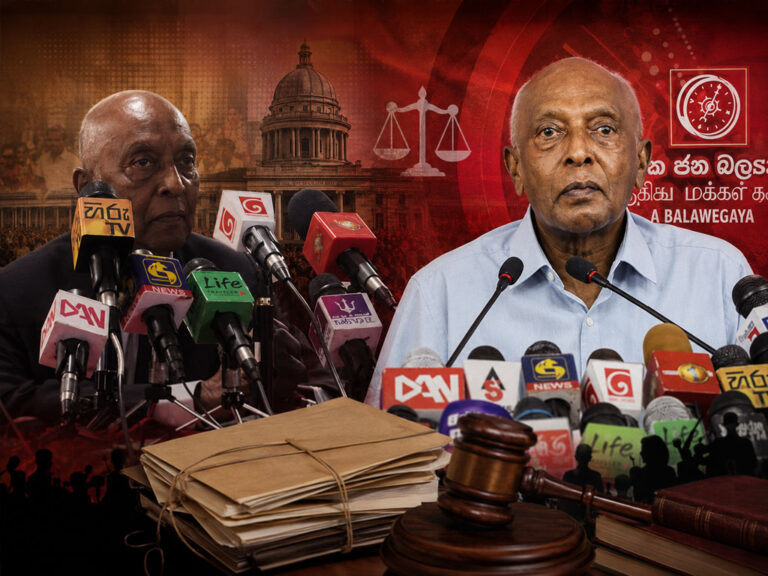
Attorney-at-Law Lal Wijenayake’s remarks at the Sri Lanka Bar Association Annual General Meeting held in Colombo on July 29 triggered a massive uproar within the government. However, that was not the first time he had voiced those thoughts. He had expressed them a day earlier, during a press conference in Colombo involving the President’s counsels and senior lawyers. That event, too, was not organized by the Sri Lanka Bar Association. Neither this writer nor anyone else who attended the press conference that day knew that Lal was going to make such a statement.
On that day, he stated that he was a member of the Leadership Council of the National People’s Power (NPP), a member of its National Executive Council, as well as a member of its Steering Committee. He emphasized that no decision had been made in any of those councils to extend the retirement age of apex court judges. He also mentioned that during a recent meeting chaired by the President, the President had clarified this matter. Lal Wijenayake further stated that he had opposed the idea, and that another member of the NPP National Executive Council later called him over the phone and asked him to remain silent on the issue.
In a private statement regarding this, Mr. Wijenayake further said that an executive council member told him, “We have to keep this person in order to get those people inside” (Note: These words have been modified by the writer to be as polite/refined as possible). Mr. Wijenayake also says that at the end of the aforementioned meeting, he addressed the President and said, “What you said using different words is the exact same thing that the other person said using those words.”
As usual, this statement by Mr. Wijenayake drew ruthless attacks from certain individuals within the National People’s Power (NPP). Some of them claimed that no one had told Lal to keep his mouth shut. Another person stated that Lal had every right to disagree.
However, none of those responses negate the depth and gravity of Mr. Lal Wijenayake’s statement. This becomes clear from what other prominent spokespersons of the National People’s Power themselves said after the incident.
Lal Wijenayake was appointed to the Leadership Council, Steering Committee, and National Executive Council of the National People’s Power (NPP) due to the importance of the leftist political tradition to which he had dedicated himself for over fifty years. Having previously served as the Leader of the Opposition in the Central Provincial Council representing the Lanka Samasamaja Party (LSSP), he and a group of others (including Dr. Jayampathy Wickramaratne PC) left the party in protest against it becoming the personal property of Tissa Vitharana and being driven entirely by his whims. The new front created by them was the New Left Front.
In the 2024 presidential election, this New Left Front split ideologically. While a group including Jayampathy Wickramaratne decided to support Sajith Premadasa, the group led by Lal Wijenayake stepped forward to support Anura Kumara Dissanayake. Anura Kumara Dissanayake’s promise of a new constitution that would abolish the executive presidency, combined with the NPP operating with a leftist political core, attracted Mr. Wijenayake to him.
Anura Kumara Dissanayake conceived the creation of the National People’s Power based on the premise that an electoral victory could never be achieved with the Janatha Vimukthi Peramuna’s (JVP) existing 3% vote base. The effort proved successful. By then, Sri Lanka Podujana Peramuna (SLPP) supporters exhausted after voting for Gotabaya Rajapaksa, as well as civil society groups left disillusioned after helping bring the Yahapalana (good governance) government into power, rapidly coalesced around the NPP. Lal Wijenayake was a principal speaker at those meetings. He was also a speaker at the final massive NPP rally held at Galle Face Green in Colombo. All of this was accorded to him because of the political legacy he represented and his standing as an individual.
Lal Wijenayake expected that once the National People’s Power (NPP) came to power, the process of drafting the new constitution promised to the public would begin. He felt entitled to that expectation because, during the Yahapalana government, Mr. Wijenayake served as the chairman of the committee appointed to consult the public islandwide for the drafting of a new constitution. Harini Amarasuriya was a member of that committee.
The “A Thriving Nation, A Beautiful Life” policy manifesto clearly states that the constitution-making process initiated during the Yahapalana government period would be resumed from where it had been halted.
Even six months after the NPP government took office, the National Executive Council of the National People’s Power did not convene. This implies that the NPP government was being governed from elsewhere. No discussion whatsoever took place regarding the new constitution either. Under these circumstances, Lal wrote a letter to the President requesting a discussion to talk about a new constitution. However, he was not granted such a meeting.
When two years had passed and the proposal to extend the retirement age of judges came to the forefront, Lal once again requested the President to convene the NPP Executive Council. It was at that Executive Council meeting that the aforementioned events transpired. It can be surmised that the meeting was called less because of Lal’s request and more because the President needed to secure support for the constitutional amendment project the government was preparing to undertake.
The statement made by Lal Wijenayake at both the aforementioned press conference and on the day of the Sri Lanka Bar Association’s Annual General Meeting clearly exposes the government’s course of action. At present, the National People’s Power (NPP) is no longer a decisive component of the government. What is taking place now is subtle marginalization—giving cold-shoulder treatment to those who elevated the NPP from 3% to electoral victory.
A significant number of those who joined the Janatha Vimukthi Peramuna (JVP) under the banner of the National People’s Power and led it to victory are now relinquishing the positions they held. From Dr. Dileepa Witharana, who left his post at the very first opportunity, to Central Province Governor Sarath Abeykoon, who resigned more recently, the personal view of many who departed is that “a massive net of JVP cadres has been cast to such an extent that it is impossible to perform their duties.”
From Hiniduma Sunil Senevi, who lacks either the strength of personality or the inclination to oppose this (he has wholeheartedly chosen to submit to “Poremola Aiya”), to Ratna Sri Wijesinghe, who resigned citing his advanced age only to accept the position once again—all of them tell the exact same story.
The weakening of non-JVP elements within the National People’s Power is no simple matter. Distinct from the rigid authoritarian conduct of a Bolshevik party, it was the NPP that added a human face to the government. Those who joined the NPP were individuals who, throughout the recent past, stood up for liberal values of democracy, the rule of law, the independence of the judiciary, rights of minority communities, and fundamental principles. As of now, they are forced to choose one of two fates.
They are left with two options: either abandon their fundamental values and acquiesce to the JVP’s backward governance, or choose silence. That is the true meaning behind the National Executive Council member’s words when telling Lal Wijenayake to “keep his mouth shut.”
This is precisely where the rarity of Lal’s statement shines through—in the fact that he belongs to neither of those two categories. Of the two, the most tragic fate has befallen the first group. Their miserable lot is to repeatedly claim they are offering “critical support” to the NPP, while using whatever theories they know to interpret every action of the government in a light that favors it.
Analyzing the government’s hasty and ill-considered decisions against a philosophical backdrop—without directly criticizing or approving them—and ultimately finding a way to signal agreement with the government’s steps has become the primary role of the majority of NPP intellectuals today. The defining feature of their arguments is that for every thousand sentences criticizing the “shattered” opposition, they throw in a single, mildly critical sentence about the government.
At the same time, they exhibit a great enthusiasm for “reimagining” the very standards they championed in the past, reshaping them to align with the government’s current desires. Accordingly, they are busy “reimagining” what a new constitution means. They are “reimagining” power-sharing with minority communities and the relevant Provincial Councils.
These days, what they are busy reimagining is the independence of the judiciary. To cover up the sheer political nakedness of this government’s desire to keep the current Chief Justice in office for another two years, these intellectuals argue that the Bar Association failed to engage in a fresh dialogue with the public regarding a total overhaul of the judicial system. Plunging the entire judicial system into immense turmoil, they offer not a single word of criticism regarding the rushed, haphazard constitutional amendment that the government is frantically trying to execute before December arrives. If they were honest, what they should actually criticize is the government’s total lack of vision or desire to engage in that deeply needed dialogue with the public about the judiciary before bringing forth such band-aid constitutional amendments. The immediate issue today is the government’s sudden, desperate rush to enact this amendment before the current Chief Justice retires on December 1st. Those busy “reimagining” seem blind to this bitter truth.
This is precisely where Lal Wijenayake stands out. Having joined the NPP out of respect for a principle he holds dear, he remains an NPP member. Yet, he possesses the backbone to step forward and call out the government’s wrongdoings for what they are.
Sinhala article