

- Rekha Nilukshi Herath
Holding a referendum in Sri Lanka would cost between Rs. 1 billion, while the Election Commission would require approximately two to two-and-a-half months to complete the necessary preparations, according to Executive Director of the People’s Action for Free and Fair Elections (PAFFREL), Rohana Hettiarachchi.
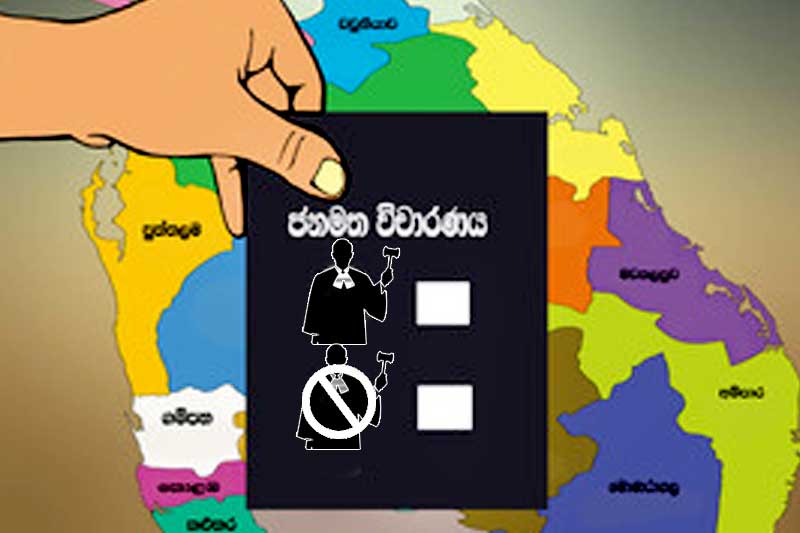
Hettiarachchi made these remarks while explaining the financial implications, legal process and administrative preparations that would be required if a referendum were to be held on the proposal to extend the retirement age of judges.
He said the cost of conducting a referendum would be comparable to that of a presidential or parliamentary election.
Explaining the nature of a referendum, Hettiarachchi referred to Sri Lanka’s 1982 “Lamp and Pot” referendum as a historical example. He noted that, unlike a general election where voters decide on multiple candidates or parties, a referendum asks the public to give a direct “Yes” or “No” answer on a single specific issue. He recalled that the 1982 referendum sought public approval to extend the term of the then Parliament.
“Although the ballot paper is simpler, resulting in some reduction in printing costs, all other expenses remain largely unchanged. Polling stations must be established, ballot boxes transported, election officials paid, transport arrangements made and security provided. Therefore, the overall cost remains between Rs. 8 billion and Rs. 9 billion,” Hettiarachchi said.
He explained that once a referendum is called, the Election Commission would need between two and two-and-a-half months to complete preparations. During this period, ballot papers must be designed and printed, polling stations established, election officials appointed and trained, election materials distributed and security arrangements coordinated with the police.
“There is no separate administrative mechanism for conducting a referendum. The same procedures followed for a general election are applied. That is why time is required for everything from training officials to making security arrangements,” he said.
Hettiarachchi further noted that a referendum differs fundamentally from a general election because voters are not asked to elect a political party or candidate but to express their opinion on a single issue.
Again referring to the 1982 referendum, he stressed that the public is asked only one specific question requiring a straightforward “Yes” or “No” response. He added that the media, political parties and civil society organisations have a significant responsibility to ensure that the public is properly informed about the issue being put to a referendum and its implications before voting.
He also pointed out that the Election Commission plays the central role in organising a referendum, while all other state institutions operate under its direction and supervision.
According to Hettiarachchi, the Commission is responsible for training election officials, coordinating election administration at district level, working with the police and other state agencies, and overseeing both the polling and vote-counting processes.
Commenting on the current legal framework, Hettiarachchi said certain constitutional amendments can be passed with a two-thirds majority in Parliament. However, he noted that the proposal to extend the retirement age of judges has drawn objections from the Bar Association of Sri Lanka, political parties and civil society organisations.
In such circumstances, he said, the President has the constitutional authority and discretion to seek the direct opinion of the people by calling a referendum.