
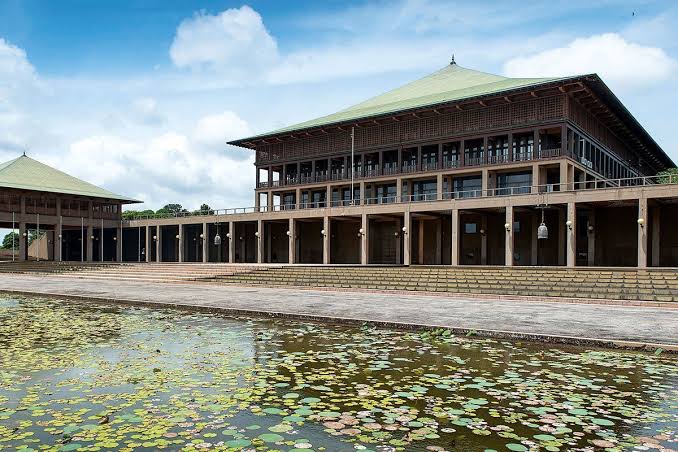

The story revealed by Parliament’s special audit report on fuel, vehicles, foreign travel, housing, and salaries
By Rekha Nilukshi Herath
The Sri Lankan Parliament is the institution that represents the sovereignty of the people. According to the Constitution, its fundamental functions are exercising the legislative power of the people, holding complete control over state finance, and supervising the executive. However, a special audit report examining how this very institution. which claims ultimate control over public funds. handled its own money now raises a separate question.
The special audit report on the 8th and 9th parliamentary terms issued by the National Audit Office examines various areas from September 2015 to November 2024, including staff management, fuel consumption, vehicle allocations, foreign travel, expenses for various offices, and official residences. The audit utilized documents, financial statements, appropriation accounts, circulars, committee reports, the parliamentary website, discussions with officials, and physical inspections.
The fundamental issue highlighted in the report goes beyond mere expenditure. A deeper concern is the systemic gaps in defining, regulating, and reviewing the financial implications of privileges attached to certain high-ranking positions within Parliament.
Parliamentary Expenditure
Between 2015 and 2024, the total expenditure incurred under three projects namely for the Speaker’s Office, the parliamentary staff, and Members of Parliament was nearly Rs. 27.99 billion.
During this period, Rs. 1.695 billion was spent on the Speaker’s Office, Rs. 16.525 billion on the parliamentary staff, and Rs. 9.773 billion on MPs.
What is notable here is the continuous increase in expenditure. In 2015, the expenditure under these three projects was around Rs. 1.73 billion, which rose to Rs. 3.62 billion by 2023. In 2024, the expenditure remained around Rs. 3.58 billion. In other words, the spending culture within Parliament stands out as a separate issue when viewed against the backdrop of the country’s economic crisis, fuel shortages, public spending cuts, and the economic burden borne by the public.
No Fuel Limits for the Speaker
One of the most striking revelations in the audit report is the fuel consumption of the Speaker. Between 2016 and 2024, a total of 299,146 liters of fuel was issued for the Speaker’s position, costing Rs. 75,260,648. The final two years demand special attention.
In 2022, the Speaker’s average monthly fuel consumption was 2,400 liters. By 2023, this increased to 3,994 liters. In 2024, it surged further to 6,122 liters. Accordingly, compared to 2022, monthly consumption rose by about 66% in 2023 and by about 155% in 2024.
In 2023, fuel for the Speaker cost Rs. 19,373,866, and in 2024, that expenditure rose to Rs. 26,045,103.
This is significant not only because fuel prices increased, but because the audit points out that no limits had been placed on the Speaker’s fuel consumption. Consequently, the audit observed that fuel usage could be carried out without restrictions.
This becomes even clearer when compared to the system applicable to other high-ranking officials in the public service. For instance, a ministry secretary or an equivalent officer has a monthly fuel limit, and specific liter limits are imposed on other positions. However, the absence of such limits for certain parliamentary positions has become a core focus of the audit.
Rs. 8.5 Million in Fuel for the Deputy Speaker’s Personal Car
The next issue concerns the position of the Deputy Speaker. Between 2016 and 2024, 204,536 liters of fuel were issued for the Deputy Speaker’s position, costing Rs. 49,363,923.
However, the most notable aspect concerns the years 2023 and 2024. According to relevant circulars, the Deputy Speaker is entitled to three official vehicles. Yet, fuel was issued for a personal motor car in addition to these three official vehicles. For that personal vehicle bearing registration number CAB-3504, 21,299 liters of fuel were issued during 2023 and 2024, amounting to Rs. 8,545,037.
The audit further reveals that in 2023, fuel exceeding the stipulated amount by 6,980 liters was drawn for the three official vehicles, while in 2024, an excess of 1,515 liters was drawn for two official vehicles.
It is important to note that Cabinet approval was granted in 2008 to provide privileges for the Deputy Speaker’s position, equating its status to that of a non-cabinet minister. However, the audit points out that subsequent public expenditure management circulars effectively allowed unrestricted fuel usage, contradicting existing limits.
Three Vehicles for a Lower Position Too
The audit also raises questions regarding the position of the Deputy Chairman of Committees. The Deputy Chairman of Committees—a position considered subordinate to the Deputy Speaker—was also allocated three vehicles, and fuel was provided without restriction, the audit observed. Furthermore, the report notes that neither the number of official vehicles nor the fuel allocation for this position had been formally determined. Between 2016 and 2024, 164,235 liters of fuel were used for this position, costing Rs. 35,049,323.
Secretary-General: Two Vehicles, 15,063 Liters of Fuel
The vehicle usage of the Secretary-General of Parliament also receives special attention in the report. A review of running charts revealed that during 2022 and 2023, the Secretary-General simultaneously used two official vehicles, identified by registration numbers KY-5555 and CAN-8753.
Between 2022 and 2024, the fuel consumed by the Secretary-General totaled 15,063 liters, valued at Rs. 6,071,690, with an annual average of about 5,021 liters. The audit points out that even when compared with the position of a ministry secretary—who receives the highest fuel allocation in the current public service—this represents an excess usage of about 2,300 liters.
Additionally, a separate issue arises regarding the Secretary-General’s salary. The audit points out that although the basic salary had increased by nearly 800% over a span of about 22 years since the salary was approved by Parliament in 2004, that salary had not been re-approved by Parliament.
State Vehicles for Private Travel
Vehicle privileges granted to senior parliamentary staff members form another major section of the report. The report indicates that a maximum limit of 1,200 kilometers per month for private travel was allocated for the Deputy Secretary-General and Assistant Secretaries-General, while a 960-kilometer limit applied to other department heads.
However, when these limits were exceeded, the charged rate of Rs. 8 per kilometer was inadequate when compared against prevailing market fuel prices at the time.
Between September 2015 and June 2022 alone, unrecovered amounts due to this system totaled Rs. 2,712,995. This included Rs. 512,312 from the Assistant Secretary-General (Administration), Rs. 1,107,876 from the Assistant Secretary-General (Legislative Services), and Rs. 1,092,807 from eight other department heads.
The audit points out that after the recovery of excess fuel usage based on market prices commenced in July 2022, such excessive usage decreased significantly. This highlights a crucial point: having a rule or limit is not enough; implementing it with financial rationality can change behavior.
Five Vehicles for the Same Officer in a Single Month
During the audit of vehicle allocations, it was revealed that two Assistant Secretaries-General were allocated multiple vehicles at various times. Instances were found where, instead of assigning a single vehicle to an officer, up to five vehicles were allocated within a single month. The report notes that even though multiple vehicles were used in this manner, the 1,200-kilometer private travel limit was still exceeded, and no valid justification for such allocations was found during the audit.
Nine Buses for 1,500 Employees Costing Rs. 335.6 Million
Nine Sri Lanka Transport Board (SLTB) buses were utilized to provide free transport facilities for the parliamentary staff from their homes to Parliament. Since 2021, these buses operated daily across nine routes, aiming to serve around 1,500 parliamentary staff members.
However, the audit points out that the expenditure incurred by the government for these nine buses between 2016 and 2024 was Rs. 335,663,253. In 2023 and 2024 alone, the annual average expenditure was around Rs. 60 million. Additionally, from June 2024 onward, another Rs. 5,887,210 was spent on drivers and conductors. Another key observation is that there was no written agreement for this bus service.
Rs. 335 Million for Free Rail Passes
It wasn’t just the nine buses; Rs. 335,663,253 was spent between 2016 and 2024 on free railway passes issued to the parliamentary staff, totaling 6,442 passes during that period. This expenditure has risen rapidly, especially since 2022. Expenditure of around Rs. 29.8 million in 2021 climbed to Rs. 58.9 million in 2022, Rs. 60.3 million in 2023, and Rs. 61.3 million in 2024.
Foreign Travel: How is Knowledge Transferred?
Through its Department of Foreign Relations and Protocol, Parliament maintains ties with organizations such as the Commonwealth Parliamentary Association (CPA), the Inter-Parliamentary Union (IPU), and the ASGP. The report states that the objectives of foreign travel are acquiring knowledge, sharing experiences, skills development, and bringing best practices into the parliamentary process.
However, the audit raises questions about how this knowledge is brought back and integrated into the Sri Lankan Parliament. Between 2016 and 2024, 115 parliamentary officials participated in 83 foreign trips through international parliamentary associations, costing Rs. 56,928,414. During the same period, another Rs. 208,932,986 was spent on foreign travels for 451 Members of Parliament.
Accordingly, the total expenditure reported for foreign travel by both parties is nearly Rs. 265,861,400. The audit points out that there was no formal mechanism for officials returning from foreign training or programs to share the knowledge and experiences they gained with relevant parties.
This is a critical issue. If the purpose of a foreign tour is to “acquire knowledge,” there must be a way to measure whether that knowledge was transferred to the institution. Otherwise, the public’s ability to determine whether foreign travel funded by state money is an institutional investment or a personal privilege becomes limited.
Another Discrepancy in the Parliamentary Library
The parliamentary library was another area examined in the report. While the library’s accession register showed a collection of 25,103 books in Sinhala, English, and Tamil as of December 31, 2024, the audit notes that the parliamentary website stated the number to be around 34,000 books.
Between 2020 and 2024, Rs. 2,879,876 was spent on books and journals, and 1,472 books were purchased during that period. While the report does not claim this alone is a major financial irregularity, it serves as an example of the broader issue of inconsistencies in maintaining parliamentary data systems, reports, and institutional information.
Inaccurate Data on Staff Positions
The report states that information on parliamentary staff provided to the audit at various times was contradictory. Data provided on October 14, 2024, indicated 181 approved positions; by December 31, 2024, it was 187; and by March 26, 2025, it was 162. According to other data, as of December 31, 2025, there were 992 approved positions, an actual staff count of 833, and 159 vacant positions.
The audit concludes that no formal data system is maintained regarding parliamentary staff. When even a basic question like “How many people are employed?” cannot yield a consistent answer during public financial control, the magnitude of potential problems in planning salaries, allowances, vehicles, fuel, and other facilities becomes clear.
Governing a New Parliament with a 70-Year-Old Law
This is perhaps the core observation tying all aspects of the report together. Financial and administrative affairs of the parliamentary staff are still primarily based on the Parliamentary Staff Act No. 09 of 1953, which the report notes was last amended in 1959. In other words, staff and financial management in Parliament operates within a legal framework decades older than the current public financial management system.
Meanwhile, the Public Financial Management Act No. 44 of 2024 introduced a new framework aimed at ensuring transparency and accountability regarding revenues, expenditures, assets, and liabilities of public institutions.
However, the audit points out that Parliament continues to function under the old Parliamentary Staff Act, and issues persist regarding compliance with the provisions of the new Public Financial Management Act. This situation raises the question of whether Parliament enjoys relative autonomy within its own financial legal framework, or whether it has become a “special zone” with diminished accountability.
Salary Increases Without Parliamentary Approval
The audit presents a very clear observation regarding the Secretary-General’s salary. According to Article 65(2) of the Constitution, the salary of the Secretary-General must be determined by Parliament. In 2004, it was approved at an annual rate of Rs. 274,920. However, the audit observed that although that salary was subsequently increased, parliamentary approval was not obtained for those increases.
According to observation 6.12 of the report, nearly 22 years after the salary was approved in 2004, the Secretary-General’s basic salary had increased by about 800%, yet formal parliamentary approval for these increases had never been secured.
Concessional Vehicle Permits: Rs. 10.8 Million Given to Three Officers Who Had Not Completed Six Years
Another specific observation relates to the issuance of motor vehicle permits on a concessional basis. According to the relevant circular, qualifying for such permits requires a minimum of six years of active service in a senior-level executive position. However, the audit observed that concessional motor vehicle permits valued at approximately Rs. 10,800,000 were issued to three parliamentary staff members before completing this required period.
Areas Lacking Direct Audit
Government grants are allocated to the Commonwealth Parliamentary Association (CPA), the Inter-Parliamentary Union (IPU), and the ASGP operating through Parliament. Between 2015 and 2024, substantial annual grants were provided to these associations—for example, in 2023, around Rs. 30.6 million was given to the Commonwealth Association and nearly Rs. 31 million to the Inter-Parliamentary Union.
However, the report points out that the financial statements of these three associations were not subject to direct audits by the Auditor General on every occasion. Since 2015, they have been audited by qualified external auditors with the concurrence of the Auditor General. This raises further questions regarding the boundaries between institutional relations involving public funds and their independence.
The Report’s Ultimate Message
When the recommendations of this special audit report are read simply, its core message is clear. First, the Parliamentary Staff Act No. 09 of 1953 must be reviewed. The audit recommends amending it to suit modern regulations or repealing it so that Parliament’s financial and staff management is brought under the current legal framework, much like other state budgetary institutions.
It emphasizes that circulars issued for government ministries and departments should also apply to Parliament’s financial management. It recommends setting specific limits on providing vehicles and fuel for the Speaker and the Speaker’s staff.
It clearly states that positions like the Deputy Speaker and Chairman of Committees should not be allowed to use vehicles and fuel beyond approved limits. The Secretary-General’s salary should be subjected to formal parliamentary approval in accordance with the Constitution, and allowances and other benefits should be provided in line with Public Administration circulars and the Establishment Code. Finally, it recommends establishing a formal mechanism to integrate knowledge acquired from foreign training and tours back into the parliamentary system.
The Issue is Much Larger Than Liters of Fuel
When reading this report, it is easy to reduce it to a simple numerical story: “How many liters did the Speaker use?” or “How many MPs went abroad?” But the true weight of the report does not lie there. The question is: what standard did Parliament—the institution vested with the power to control public funds—practice in managing its own money?
Allowing unrestricted fuel for certain high-ranking parliamentary positions while other public officials face fuel limits, permitting a single officer to use multiple vehicles at once, providing fuel for personal cars, granting special privileges to use state vehicles for private travel, charging rates lower than market prices when limits are exceeded, maintaining inconsistent staff data, and running financial control on a law nearly 70 years old can all be seen as different faces of the same systemic problem.
Therefore, the final recommendation of the audit goes far beyond fuel limits. It is a call to modernize Parliament’s financial control, staff management, and privilege systems as a whole. The question now before the public is: how transparent is the institution that constitutionally claims complete control over the people’s money regarding its own expenses?