
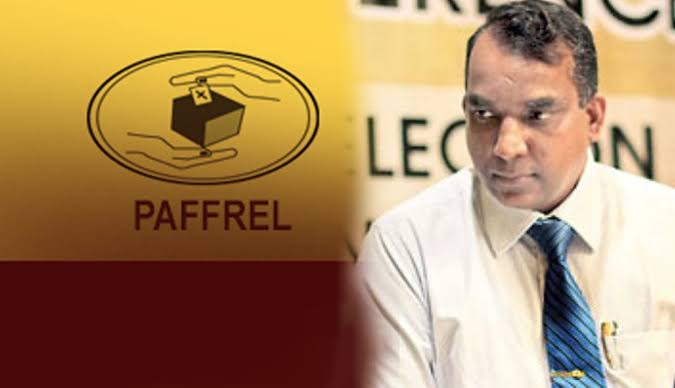

The People’s Action for Free and Fair Elections (PAFFREL) has urged President Anura Kumara Dissanayake not to restrict the public’s and media’s right to use information regarding assets and liabilities through the proposed new amendments to the Anti-Corruption Act.
This request was made in a letter sent to the President by PAFFREL Executive Director Rohana Hettiarachchi on August 24.
PAFFREL points out that allowing the public to publicly use assets and liabilities declarations through the Anti-Corruption Act No. 9 of 2023 was a significant forward step in Sri Lanka’s anti-corruption process.
However, the organization states that the Anti-Corruption (Amendment) Bill, gazetted on July 24, proposes to impose restrictions on using such declarations for any purpose other than legal proceedings.
According to the proposed amendment, a person obtaining an edited copy of another person’s assets and liabilities declaration will not be able to use it for any purpose other than submitting it to the relevant official or institution, PAFFREL notes.
The letter states that such a restriction would make the public’s use of information granted through the act a criminal offense, thereby restricting the right to access and socialize such information.
PAFFREL points out that journalists, civil society, and interested citizens should have the ability to identify discrepancies in assets and liabilities declarations and to investigate whether a person’s assets can be justified by their legal income.
Restricting the use of such information could be detrimental to the anti-corruption process itself, the organization adds.
However, PAFFREL stated that they have no issue with enforcing the law against those who distort assets and liabilities declarations with the intention of defaming individuals in society.
Nevertheless, the organization emphasizes that the public’s right to find out whether individuals holding public property and public power have made illegal gains through them, or the right of external parties including the media to inform the public, should not be restricted.
Meanwhile, PAFFREL points out that an amendment has also been proposed regarding Section 80(B) of the Anti-Corruption Act. The letter mentions that it has been proposed to raise the threshold for heads of institutions where the government or a government corporation holds not less than 25% share ownership to submit assets and liabilities declarations up to 50%.
Consequently, a situation may arise where heads of institutions with state ownership of up to 49.9% will not have the responsibility of submitting assets and liabilities declarations, which PAFFREL points out is contrary to the objective of eradicating bribery and corruption.
Additionally, the organization states that certain provisions in the proposed amendments risk centralizing the powers of the Commission to Investigate Allegations of Bribery or Corruption (CIABOC) too much around a single individual.
While expressing trust in the current Director General, PAFFREL stated that the power of an independent commission should not rest on a single individual, but rather on the commission or a formal institutional structure.
Furthermore, PAFFREL points out that the new bill proposes to remove the requirement to disclose the assets and liabilities of a person who has lived with the declarer for at least six months.
The letter states that removing this provision could create an opportunity to conceal assets by transferring assets controlled by a person or benefiting that person into the name of another individual living with them.
However, PAFFREL does not oppose all provisions of the new amendment bill, acknowledging that it contains several positive aspects, including the inclusion of a number of fields previously unincluded in the act and the resolution of certain ambiguities.
Nevertheless, PAFFREL emphasizes that the progress achieved through the Anti-Corruption Act in 2023 should not be allowed to be reversed by any amendments.
The organization also states that anti-corruption laws must be further strengthened within an environment that protects the public’s right to hold power holders accountable, as well as the right to access, use, and share information.
Accordingly, PAFFREL has requested the President to subject the proposed anti-corruption amendment bill to a broad public dialogue and to carry out reforms that further protect the accountability of power holders and the public’s right to information.